WCAG 2.2 aligned
Structured reviews aligned to WCAG 2.2 Level A and AA expectations.

A Verify audit tells you exactly where your website or app does not yet meet WCAG 2.2 Level AA, what to fix first, and how. You get evidence you can put in front of a procurement panel, an auditor or your board.

Structured reviews aligned to WCAG 2.2 Level A and AA expectations.
Expert assessment informed by lived experience and real-world usability.
Prioritised findings with clear recommendations for delivery teams.
Review outputs shaped to support remediation, planning, and progress.
Organisations preparing for a tender, a launch, a contract renewal or a complaint.
Findings prioritised and mapped to each template and WCAG 2.2 criterion, two retests within 90 days, a walkthrough with your team, and a dated Conformance Evidence Pack mapped to WCAG 2.2 AA and AS EN 301 549.
The WCAG-EM method: manual expert testing across browsers and assistive technologies, with automated checks as support. Priced on templates and journeys, not page count.
About 2 weeks for up to 8 templates, 3 weeks for 9 to 15, and 4 to 5 weeks for 16 to 25.
Australia-wide, remote.
Automated tools are a useful starting point, but they weren’t designed to deliver accessibility. Verify combines expert assessment with practical workflows so your team can understand, prioritise and ac
Accessibility specialists review and validate findings before they’re reporte
Shared component and template issues are identified once and tracked at the source.
Management summaries for decision-makers and technical guidance for implementers.
Prioritised recommendations with context, examples and next steps.
Search issues, add comments, assign owners and track progress in one place.
You get the insight and confidence to prioritise and drive meaningful change.

There’s website compliance and then there’s website usability. Getting feedback directly from people with disability about what a website is like to actually use is the best way to improve and create positive change.
Our guide sets out six things to check and seven questions to ask any provider, including us.
Accessibility specialists identify and validate issues.
The IncluD Platform helps your team understand, prioritise and resolve them.
Every finding is validated by accessibility specialists.
Discuss, assign and track every issue.
Prioritised by impact, effort and user experience.
Better outcomes for everyone.
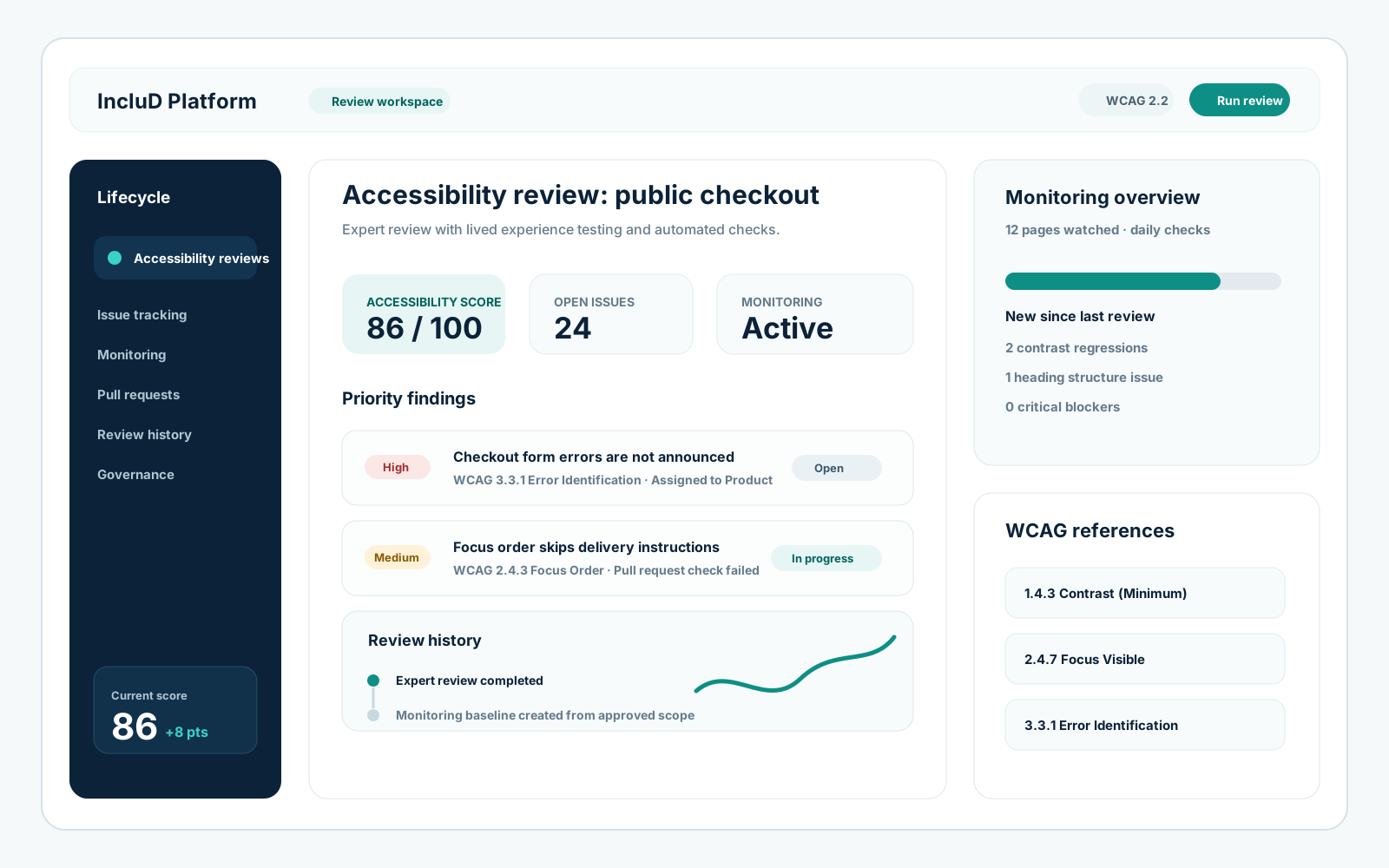
Verify turns accessibility testing into clear, prioritised action — so your team can focus on the issues that matter and move forward with confidence.
A structured evaluation of a website or app against WCAG 2.2, combining automated testing, expert manual review and assistive technology testing to identify and prioritise the barriers that prevent people with disability from using it.
It depends on the size and complexity of your website or app, which is why IncluD scopes every audit individually. For most audits we can quote directly from a 15-minute call, at no cost. For larger or more complex sites, the $1,500 + GST Accessibility Readiness Report scopes the work with you and produces an accurate price, credited back in full when you engage us within 90 days.
Automated tools evaluate around 30 to 40 percent of WCAG criteria, the ones machines can detect. A full audit adds expert manual review and assistive technology testing, covering the majority of criteria that require human judgement, and traces findings to their root cause so one fix resolves the issue everywhere it appears.
It depends on scope. A focused review of your highest-priority user journeys can be completed in a few weeks; a full-site WCAG 2.2 Level AA audit takes longer. We confirm the timeline when we scope the work, and the Readiness Report is the fastest way to get that scope.
At minimum after significant redesigns or major releases, and at least annually for websites and apps in active development. IncluD Monitor provides continuous automated monitoring between formal audits so regressions are caught early.
The Disability Discrimination Act 1992 does not mandate audits specifically, but it makes inaccessible digital services unlawful. An audit provides the evidence that you have taken reasonable steps, which is the relevant legal test, and gives you the plan to close the gaps it finds.